


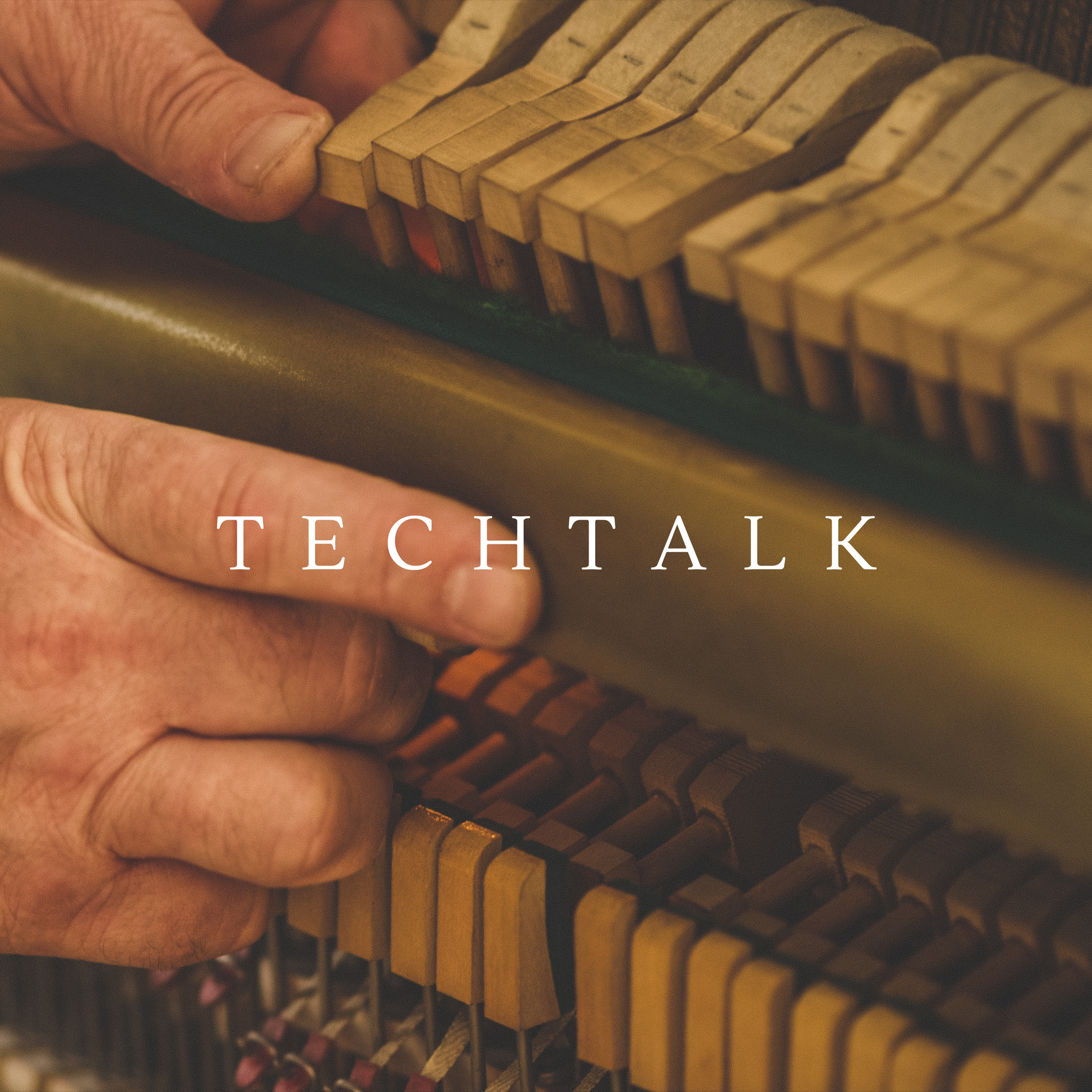
Welcome to our informational series called tech talk. I will be guiding you through a series of posts helping you better understand the piano from multiple viewpoints, as a pianist, performer and piano technician.
While studying at the Conservatory, it was always a challenge to find a piano in the basement practice rooms that was in tune, wasn't missing any strings, and that was regulated to a point that I was not frustrated for the hours of time I spent with it. It was this experience that led me to seek more knowledge about the instrument I spent so much time with.
The piano is composed of multiple systems, mechanical and structural, that work together within the laws of physics. All work together to create a whole, and the better the systems interact with each other, the better the outcome of sound and music from the musician. It is essential that each of these systems is in good working order so that their interactions are correct and efficient. Every mechanical adjustment is in some way dependent upon another. When they all work together properly, there is a most pleasant experience in playing the instrument and the piano is able to give back exactly what you ask of it, within its limits.
Let’s first consider the piano hammer when it is raised to a position in close proximity to the string. As the hammer is raised very slowly in a controlled manner, you will see that it never comes in contact with the string. If it does, there are other problems. When the hammer is raised to its highest position, the distance between the hammer and the string is referred to as let-off. This adjustment, in and of itself, creates the greatest perceived improvement in control by the pianist. But wait, its not that easy. This let-off distance must work in concert with a few other adjustments like drop, back check distance, repetition lever spring tension and others.
Check in again as we explore in depth the inner workings of your beloved instrument.
Comments will be approved before showing up.


In July 2026, Stanford reported on a study led by concert pianist Elizabeth Schumann, the Billie Bennett Director of Keyboard Programs at Stanford, with support from the Wu Tsai Human Performance Alliance.


On March 26, 2027, it will be exactly 200 years since Ludwig van Beethoven died in Vienna.
The anniversary is still six months away. But across Europe and the United States, the celebrations have already started.
And for anyone who plays the piano, this one feels personal.


The world of piano music is having a remarkable moment. From concert halls to streaming playlists to social media feeds, the piano is more culturally visible than it has been in decades. Here's a look at the biggest trends shaping how we listen to, play, and think about piano music right now.